

Hearing on the Rejection of a Naturalization Application: Why Discontinued Criminal Proceedings Can Become a Problem
A discontinued criminal investigation can still raise doubts about constitutional loyalty during naturalization proceedings.
Hearing on the Rejection of a Naturalization Application: Why Discontinued Criminal Proceedings Can Become a Problem
A discontinued criminal investigation can still raise doubts about constitutional loyalty during naturalization proceedings.
In the naturalization process, the hearing (known in German administrative law as the Anhörung) is regularly a key procedural step. It gives applicants one final opportunity to present their perspective on the facts before a decision is reached, and to clear up any misunderstandings. In some cases, the authorities will have specific concerns that stand in the way of naturalization, and the hearing is the proper forum for addressing these substantively. Both parties have particular obligations at this stage: while the authority must support its concerns with concrete facts, the applicant is also expected to cooperate and help dispel any doubts.
With over ten years of experience, Schlun & Elseven Rechtsanwälte is one of Germany’s leading immigration and citizenship law firms. Our attorneys work collaboratively across practice areas — including citizenship, immigration, and criminal defense — to deliver well-rounded legal support on complex cases. As a digital-first firm offering full-service support in English, we regularly advise international clients at every stage of the German naturalization process, from initial applications through to hearings and appeals.
The Hearing as a Warning Sign: Last Chance Before Naturalization Is Rejected
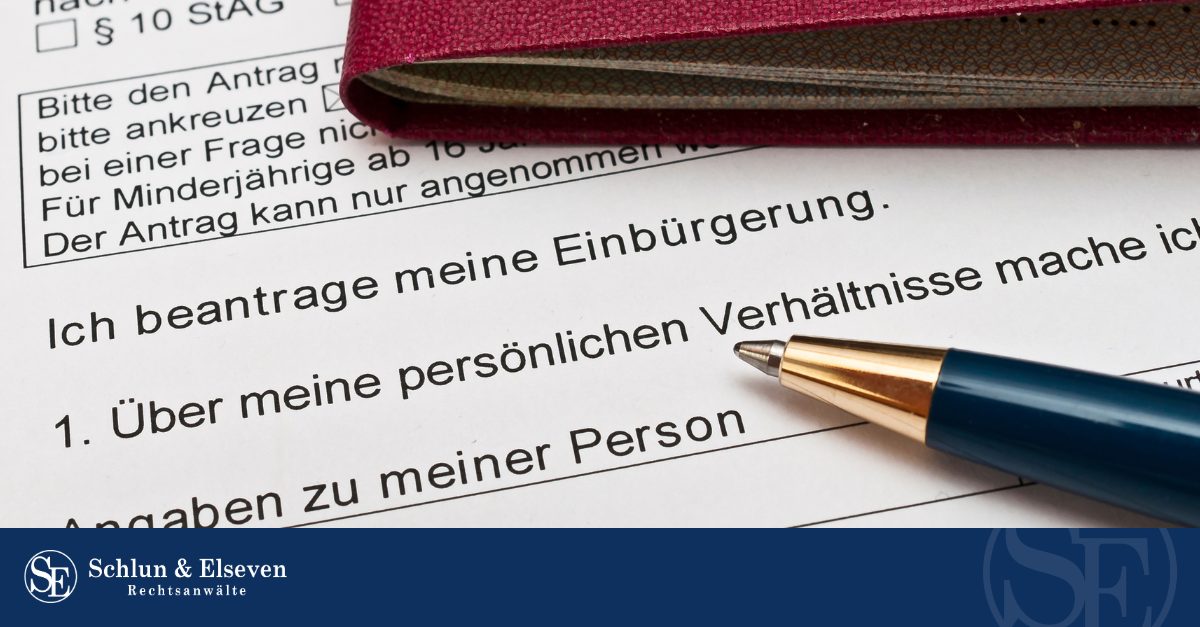
The significance of the hearing is especially clear when doubts arise regarding what is known as Verfassungstreue — loyalty to the constitutional order. Under Section 10(1)(1) of the Nationality Act (Staatsangehörigkeitsgesetz, StAG), naturalization applicants must declare that they are committed to the free democratic basic order (freiheitlich demokratische Grundordnung) established by Germany’s Basic Law (Grundgesetz), and that they neither pursue nor have supported any efforts directed against it.
It can happen that applicants, having submitted such a declaration, are then confronted by the authority with doubts about whether they genuinely meant it. This occurs when the authority has concrete indications of past or current anti-constitutional or extremist activity. In some circumstances, naturalization may be denied on these grounds.
Particularly Under Scrutiny: WhatsApp Groups and “Lip Service”
When it comes to doubts about the constitutional loyalty declaration, content shared in chat groups — such as racist jokes or extremist memes — is a particular focus for the authorities. In some cases, the authority interprets such content as evidence of an anti-constitutional mindset and concludes that the applicant’s commitment to the free democratic basic order amounts to nothing more than an “empty lip service declaration” (inhaltlich unrichtiges Lippenbekenntnis).
However, a declaration cannot be deemed false simply because the authority harbors doubt about the applicant’s inner attitude. The authority requires objective facts — that is, concrete indications based on outwardly observable behavior or circumstances relating to the applicant personally.
This is why it is particularly important, even at the initial application stage, to make this declaration credibly and with supporting context. Should the immigration authority still harbor doubts, the evidence it cites in support of the “empty lip service” claim must be carefully examined and addressed. Do the shared contents genuinely and unambiguously indicate an anti-constitutional mindset on the part of the specific applicant, and can they actually be reliably attributed to that person?
In such cases, the authority will send the applicant a formal hearing notice (Anhörungsschreiben), informing them that it is considering rejecting the application due to doubts about their “inner attitude” and setting a deadline for the applicant to respond. This hearing notice — and the deadline it contains — is a critical warning signal. Anyone who allows that deadline to pass without responding risks having their application rejected outright.
Applicants should therefore carefully examine — ideally with the support of a lawyer — exactly what the authority is basing its doubts on. Formally requesting access to the full administrative and investigative files (Akteneinsicht) can be helpful here, as it allows the applicant to determine precisely which “concrete indications” are being relied upon and whether they can actually be attributed to the applicant or whether there is a mistaken connection. A well-founded response can then be prepared accordingly. If the concern relates to past anti-constitutional activity, it will be necessary to demonstrate credibly that the applicant has distanced themselves from that conduct and that their attitude has genuinely changed.
Naturalization: Why Even Discontinued Criminal Proceedings (Section 170(2) of the Code of Criminal Procedure) Can Become a Problem
For a naturalization application to succeed, the applicant must generally have no criminal convictions that stand as a bar to naturalization under nationality law. Specifically, the applicant must not have been convicted of an unlawful act, nor may a measure of rehabilitation and security (Maßregel der Besserung und Sicherung) have been ordered against them due to their incapacity for guilt. What is decisive here is whether a final conviction (rechtskräftige Verurteilung) has actually been handed down.
If an investigation is discontinued under Section 170(2) of the Code of Criminal Procedure (Strafprozessordnung, StPO) — meaning the prosecution has determined there is insufficient suspicion to proceed — there is no criminal conviction. In principle, a discontinued proceeding is therefore not considered when assessing the conditions for naturalization.
However, a naturalization decision is an independent administrative law assessment, in which the authority evaluates all circumstances bearing on the applicant’s “loyalty” to the free democratic basic order — regardless of how any criminal proceedings concluded. The authority considers all relevant information available to it.
This means that findings from a discontinued investigation can still be factored into this overall assessment — specifically when those findings are sufficiently established and raise doubts about the applicant’s constitutional loyalty. Put differently, the authority may harbor its own doubts about an applicant’s loyalty even where no judge has convicted them of any related offense.
That said, the authority is strictly required to uphold the applicant’s presumption of innocence (Unschuldsvermutung). It may not treat the applicant as though they were convicted on the basis of a discontinued proceeding, and it therefore cannot use findings from such a proceeding as blanket proof of a lack of loyalty.
Schlun & Elseven Rechtsanwälte: Support When Your Naturalization Application Is at Risk
Threatened naturalization rejections often sit at the intersection of immigration law and criminal law — and that is precisely where our cross-practice approach adds the most value. Our criminal defense lawyers and citizenship law specialists work together to build a coordinated strategy tailored to your case. Our services when naturalization is at risk of rejection include:
- Immediate access to the file: We request the complete administrative file and the prosecution’s investigative file to identify precisely which chat histories or evidence are being held against you.
- Strategic response at the hearing: We prepare a legally substantiated reply to the hearing notice, aimed at countering the authority’s doubts regarding your constitutional loyalty (Section 11 StAG).
- Challenging criminal law accusations: We argue before the naturalization authority why a discontinued proceeding (Section 170(2) StPO) may not be used as evidence of an anti-constitutional mindset.
- Defense against “loyalty” doubts: We help you address any misunderstandings regarding shared content (e.g., in WhatsApp groups) and build a credible legal case for your commitment to the free democratic basic order.
- Contesting rejection decisions: If a rejection notice has already been issued, we represent you in the formal objection process (Widerspruchsverfahren) or in proceedings before the Administrative Court (Verwaltungsgericht).
- Preventing knock-on effects: We work to ensure that findings from the naturalization file do not negatively impact your existing residence permit (Aufenthaltstitel).
If you have received a hearing notice or are concerned about how past criminal proceedings may affect your naturalization application, our team is available to advise you promptly and in English across all relevant practice areas.




International expertise

Interdisciplinary

Transparent processes

Personalised
Contact Schlun & Elseven Rechtsanwälte
Legal Representation Throughout Germany
Please use the form below to tell us about your legal matter.
Once we receive your enquiry, we will provide an initial assessment based on the information you have supplied and send you a transparent fee proposal.
Your Benefits


Legal Representation Throughout Germany
Alternatively, you can contact us directly using the contact details provided.
- 24h Contact: +49 221 93295960
- Email: info@se-legal.de


